


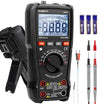

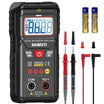
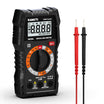
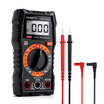
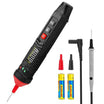
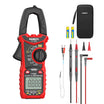
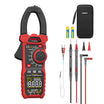
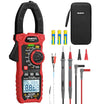
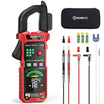
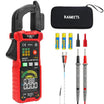
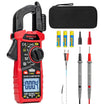
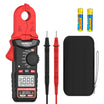

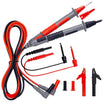
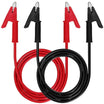
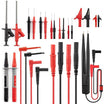
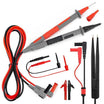

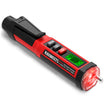
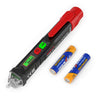
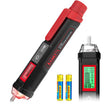
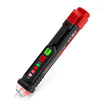
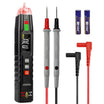
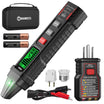
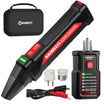
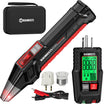
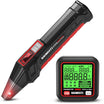


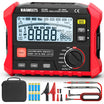





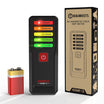












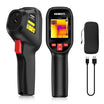

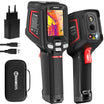
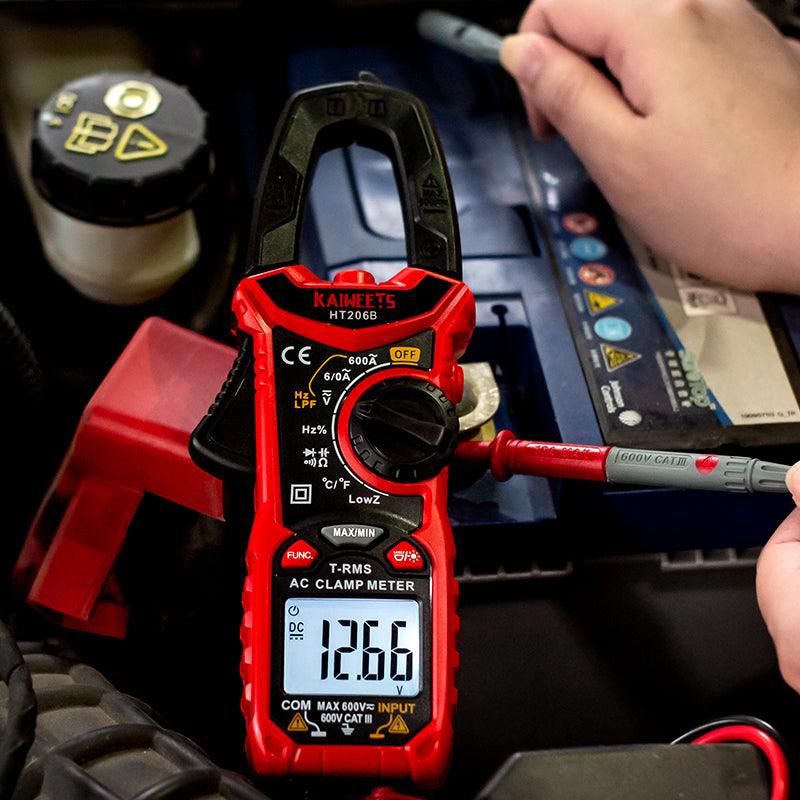
A clamp meter can help you check a car battery, but voltage and current require different measurement methods. Use the test leads to measure voltage across the battery terminals. Use the clamp jaw to measure DC current through one battery cable.
Do not place the clamp jaw around both battery terminals. The jaw is designed to detect the magnetic field around a current-carrying conductor, not to make electrical contact with battery posts.
What can a clamp meter measure on a car battery?
A suitable clamp meter can check battery voltage with its test leads and current through one cable with its jaw.
- Battery voltage: Use the red and black test leads across the battery terminals.
- Key-off current draw: Clamp the jaw around one battery cable.
- Charging or cranking current: Use a DC clamp meter with a current range high enough for the test.
Many clamp meters can also measure resistance or continuity through their test leads. These functions must only be used on circuits that are powered off and isolated from the battery.
What should you check before testing?
Confirm that the meter supports the function you need and that the battery is safe to approach.
Many basic clamp meters measure only AC current through the jaw. Automotive battery testing requires a model that can measure DC current. Before testing, check the specifications and instructions for your clamp meter.
- Turn off the engine and electrical accessories.
- Wear eye protection and suitable gloves.
- Remove metal jewelry before working near the terminals.
- Keep sparks and open flames away from the battery.
- Do not test a battery that is swollen, cracked, frozen, or leaking.
This guide applies to conventional 12-volt vehicle batteries. Do not work on an electric vehicle traction battery or an exposed high-voltage system unless you have the required training.
How do you test car battery voltage with a clamp meter?
Use the meter’s test leads across the battery terminals; do not use the clamp jaw for a standard voltage test.
- Park the vehicle safely and switch off the engine.
- Turn off the lights and other electrical accessories.
- Allow the battery to rest after driving or charging so surface charge does not distort the result.
- Insert the black test lead into the COM terminal.
- Insert the red test lead into the voltage terminal marked V or VΩ.
- Set the meter to DC voltage, shown as V with a solid line above a dashed line.
- Place the red probe on the positive (+) battery terminal.
- Place the black probe on the negative (-) battery terminal.
- Read the voltage shown on the display.
- Remove the probes without allowing them to touch each other or nearby metal parts.

What voltage should a car battery show?
A fully charged 12-volt lead-acid battery commonly reads about 12.6 to 12.8 volts after resting.
- About 12.6 to 12.8 V: The battery is fully charged or close to fully charged.
- About 12.4 V: The battery is partially discharged.
- Near 12.0 V or below: The battery is deeply discharged and should be recharged.
- About 13.7 to 14.7 V with the engine running: This is a common charging-system range.
These values are general references. Temperature and battery type can affect the reading. Modern vehicles may also vary charging voltage as the battery management system responds to driving conditions.
A normal open-circuit voltage does not prove that the battery can deliver enough starting current. A battery may show more than 12.6 volts and still fail under load.
How do you measure battery current with the clamp jaw?
Set the meter to DC amps, zero the display, and clamp the jaw around one battery cable.
- Confirm that the clamp jaw supports DC current measurement.
- Select the DC amp setting and an appropriate measurement range.
- Close the empty jaws completely.
- Press the zero or relative button if the meter provides one.
- Open the jaws and place them around one insulated battery cable.
- Position the cable near the center of the jaw.
- Close the jaws completely and read the display.
The negative battery cable is often the most convenient conductor to measure. A negative value usually means the clamp is facing the opposite direction from the current-flow indicator. Reversing the clamp should change the sign without changing the approximate magnitude.
Why must you clamp around only one cable?
The jaw measures the magnetic field produced by current in a single conductor.
If the jaw surrounds both the positive and negative cables, their magnetic fields oppose each other. The meter may then display a reading close to zero even when current is flowing.
How can you improve DC current accuracy?
Correct setup is especially important when measuring the small current involved in battery-drain testing.
- Make sure the jaw surfaces are clean and fully closed.
- Zero the meter with no conductor inside the jaw.
- Keep the cable near the center of the jaw.
- Use the lowest safe range that provides enough resolution.
- Keep the meter away from strong external magnetic fields.
A general-purpose high-current clamp meter may not have enough resolution to measure very small parasitic loads. Check the meter’s resolution and accuracy specifications before relying on a low-current reading.
How do you check for parasitic battery drain?
Measure key-off current after the vehicle’s electronic modules have entered sleep mode.
- Switch off the engine and remove the key from the vehicle.
- Turn off accessories and make sure interior lights are not operating.
- Close the doors, or carefully latch the door switches if access is required.
- Wait for the vehicle’s control modules to enter sleep mode.
- Set the clamp meter to a low DC current range.
- Zero the meter with the jaws closed and empty.
- Clamp around one negative battery cable.
- Watch the reading until it becomes stable.
- Compare the result with the vehicle manufacturer’s service information.
Some modules remain active for several minutes after the vehicle is switched off. Opening a door or using the remote can wake them again and temporarily increase the reading.
There is no single acceptable parasitic-draw limit for every vehicle. Newer vehicles may have security systems or connected services that continue to use power. Use the manufacturer’s specification whenever possible.
Do not start the engine while the meter is set to a sensitive low-current range. Starter current can reach hundreds of amps. Measuring it requires a clamp meter with a suitable range and, ideally, an inrush-current function.
How should you interpret the test results?
Use voltage and current readings as screening information, then compare them with the vehicle’s specifications.
- Low resting voltage: Recharge the battery before performing further diagnosis.
- Normal voltage but poor starting: The battery may need a load or conductance test.
- High key-off current: A module or circuit may be draining the battery.
- Abnormal running voltage: The charging system may require further testing.
A clamp meter cannot identify battery capacity or cold-cranking performance from voltage alone. It also cannot determine which circuit is responsible for a drain without additional troubleshooting.
What should you do if the battery is discharged?
Recharge the battery with a compatible charger before deciding that it needs replacement.
- Inspect the battery for visible damage before charging it.
- Use a charger that matches the battery chemistry and voltage.
- Follow the charger and vehicle manufacturer’s connection instructions.
- Allow the battery to charge fully before testing it again.
- Have the battery professionally tested if it quickly loses charge.
A jump start may get the engine running, but it does not fully recharge a deeply discharged battery. After a jump start, the battery may still require controlled charging.
If the battery repeatedly becomes discharged, check for a parasitic load or a charging-system problem. Replacement should be based on proper testing rather than voltage alone.

Frequently Asked Questions About Car Battery Clamp Meter Testing
The main points are that voltage uses test leads, while current uses the clamp jaw.
Can the clamp jaw measure battery voltage?
Most clamp meter jaws measure current rather than battery voltage. For a standard 12-volt battery test, connect the test leads directly across the positive and negative terminals.
Some specialized meters offer contactless voltage functions. Follow the model-specific instructions because these features do not replace the normal terminal-voltage test in every application.
Can any clamp meter measure car battery current?
No. The clamp must support DC current measurement.
An AC-only clamp meter cannot correctly measure steady current from a 12-volt car battery. The meter must also have enough resolution for the current level being tested.
How does a DC clamp meter work?
A DC clamp meter detects the magnetic field produced by current flowing through a conductor.
A sensor inside the jaw converts that magnetic-field measurement into a current value. This allows current to be measured without disconnecting the battery cable.
How accurate are DC clamp meters?
Accuracy depends on the meter’s specifications and the way it is used.
DC offset can affect small readings, so the meter should be zeroed before testing. Jaw closure and conductor position also matter. For parasitic drain, confirm that the meter is designed to measure current in the required milliamp range.
Is 12 volts a good car battery reading?
A reading of exactly 12.0 volts usually indicates that a 12-volt lead-acid battery is significantly discharged.
A fully charged battery commonly reads about 12.6 volts or higher after resting. However, voltage alone cannot confirm whether the battery will perform correctly under load.
Can a clamp meter test the alternator?
A clamp meter can help evaluate charging current, while its test leads can check charging voltage.
The results must be interpreted with the vehicle’s charging strategy in mind. A smart charging system may intentionally raise or lower alternator output.
What should you remember before testing?
Use the test leads for battery voltage and the clamp jaw for current through one cable.
Confirm that the meter supports DC current before using the jaw. Zero the meter before low-current testing and compare the result with vehicle-specific information. When voltage appears normal but the battery still struggles to start the engine, use a proper battery load or conductance test.


Leave a comment
All comments are moderated before being published.
This site is protected by hCaptcha and the hCaptcha Privacy Policy and Terms of Service apply.